


Terry Davis, Master Electrician & Owner, TL Davis Electric & Design
Date: January 1, 2026
Service Region: Tulsa, Broken Arrow, Claremore, Owasso, Jenks, Bixby, and surrounding communities.
Bottom Line Up Front (BLUF)
As a Master Electrician with over three decades of experience spanning from the high-rise hotels of Denver to the historic neighborhoods of Midtown Tulsa, I have seen nearly every failure mode an electrical system can exhibit. The bottom line is this: Your home’s electrical system is a dynamic, aging infrastructure that requires proactive stewardship, not just reactive repair.
In Northeast Oklahoma, we face a unique convergence of challenges: the latent fire risks posed by 1970s aluminum wiring in suburban Broken Arrow, the delicate degradation of knob-and-tube systems in historic Tulsa, and the severe surge threats to rural properties in Oologah and Mannford due to our intense storm seasons. The State of Oklahoma’s recent adoption of the 2023 National Electrical Code (NEC) has raised the bar for safety, mandating advanced protections such as whole-home surge suppression and expanded arc-fault detection.
This report is written directly to you, the homeowner. It is designed to answer your most pressing questions with the transparency and technical depth you deserve. My goal is to move you from a state of uncertainty to one of informed confidence, ensuring that when you do hire a professional, you know exactly what to ask, what to expect, and why quality workmanship is the only investment that pays off in safety.
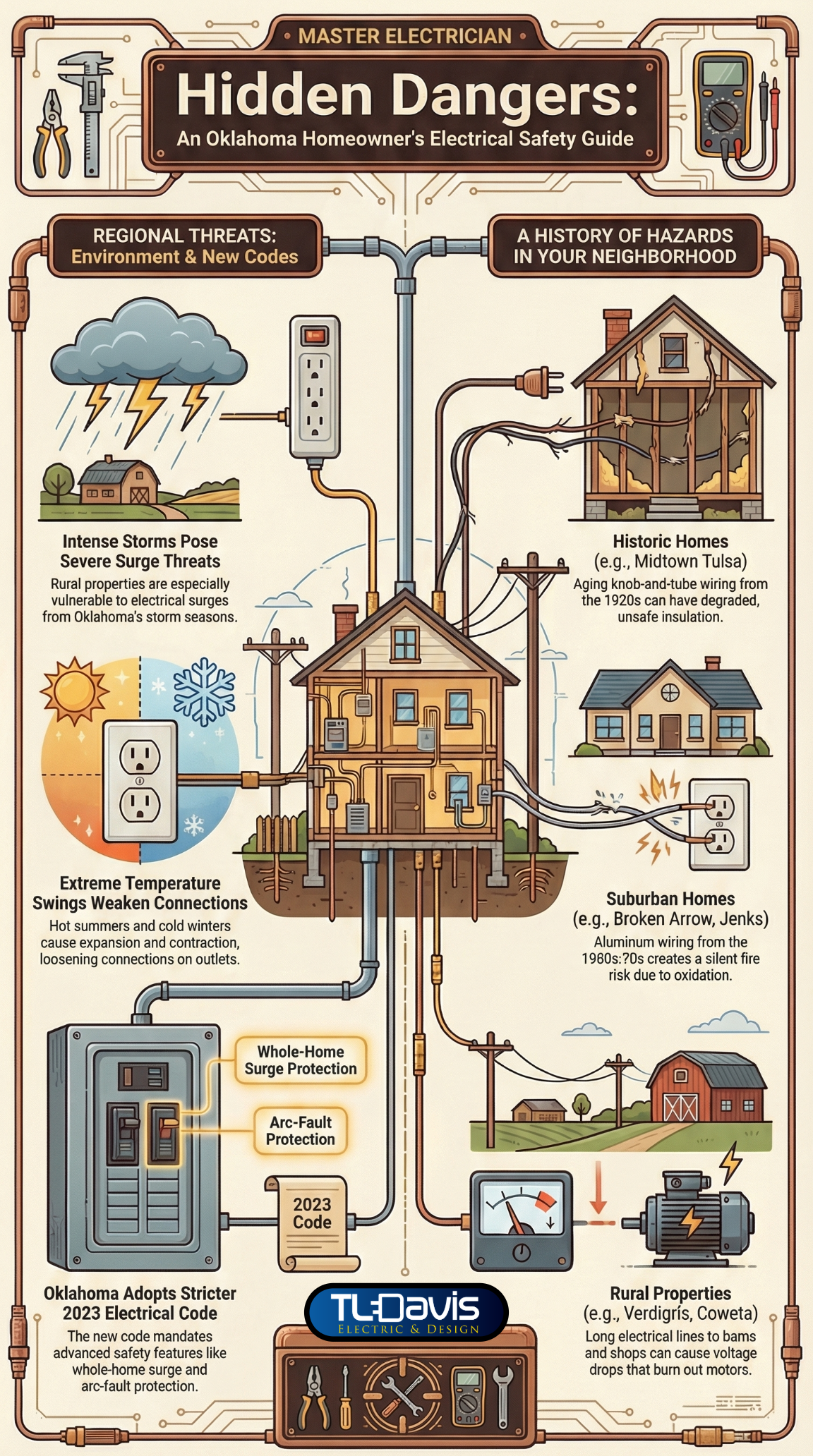
Table of Contents
- Introduction: The TL Davis Standard & The Oklahoma Electrical Landscape
- Chapter 1: Diagnostics – Understanding Power Loss & Circuit Failure
- Chapter 2: The Sensory Audit – Interpreting Warning Signs
- Chapter 3: The Safety Net – GFCI & AFCI Protection Standards
- Chapter 4: Environmental Defense – Surge Protection & Fire Prevention
- Chapter 5: Infrastructure Upgrades – Fans, Fixtures, & Panel Capacity
- Chapter 6: Assessing System Health – Wiring Age & Inspection Protocols
- Chapter 7: Vetting Your Electrician – Credentials & Specialization
- Chapter 8: The Financials – Transparency in Pricing & Estimates
- Chapter 9: The Regulatory Framework – Permits, Codes, & Compliance
- Chapter 10: The Guarantee – Warranty, Follow-Up, & Safety Protocols
- Closing Summary
- Reference Tables
- References
Introduction: The TL Davis Standard & The Oklahoma Electrical Landscape
I founded TL Davis Electric & Design & Design in 2016 on a simple premise: precision, integrity, and real-world expertise. My journey began in Southern California, where I cut my teeth as a journeyman, but it was refined in Denver, Colorado. There, I managed electrical contracts for massive projects from the Broncos’ NFL stadium to high-rise hotels like the Red Lion and Sheraton. That commercial rigor taught me that “good enough” is a failure waiting to happen. When I moved my family to Oklahoma in 2009 during the economic downturn, I brought that high-stakes commercial discipline to the residential market.
Northeast Oklahoma presents a specific set of electrical variables that differ from anywhere else I’ve worked. In our service area stretching from the Arkansas River valleys of Bixby to the rural expanses of Rogers County, we deal with extreme thermal cycling. Our summers bake attics to 140°F, and our winters can freeze pipes. This expansion and contraction wreaks havoc on electrical connections, particularly on the “back-stabbed” outlets found in many spec homes built in the 1990s and 2000s.
Furthermore, our housing stock is a geological record of electrical history. In Midtown Tulsa, I routinely encounter knob-and-tube wiring from the 1920s that has lost its insulation. In the suburban booms of the 1960s and 70s in neighborhoods like Broken Arrow and Jenks, we find aluminum wiring that poses a silent fire risk due to oxidation. And in our rural communities like Verdigris and Coweta, long feeder lines to barns and shops suffer from voltage drop that burns out motors.
This report addresses these local realities head-on. I am writing this in the first person because I want you to feel as though we are standing at your kitchen island, discussing your home’s safety.
Chapter 1: Diagnostics – Understanding Power Loss & Circuit Failure
When the lights go out or an outlet dies, it is rarely a random event. It is a symptom of a specific failure in the continuity of your home’s electrical grid.
1.1 Why isn’t this electrical outlet working, and what could be causing it?
A non-functional outlet is the most common service call we receive at TL Davis Electric & Design. When I walk into a home in Owasso or Claremore to diagnose this, I am mentally running through a hierarchy of probabilities based on the circuit’s physics.
The “Daisy Chain” Effect: Most residential outlets are wired in a series, much like old Christmas lights. We call this “daisy-chaining.” If a wire comes loose at one receptacle—perhaps the one behind your couch that you never use—it breaks the path for every outlet “downstream” from it. You might be frustrated that your TV outlet isn’t working, but the actual failure point could be in a completely different room.
Tripped Safety Devices: Often, the culprit is a tripped Ground Fault Circuit Interrupter (GFCI). In modern homes, a GFCI outlet in a garage might protect the outlets in your bathrooms or outdoor patios. If that garage GFCI trips due to humidity or a faulty tool, your bathroom outlet goes dead. Homeowners often assume the breaker in the panel is the issue, but it’s actually a localized safety trip hidden behind a pile of boxes in the garage.
Back-Stabbed Connections: This is a widespread issue in Oklahoma’s tract homes. To save time during construction, electricians often push wires into the back of an outlet (back-stabbing) rather than wrapping them around the screw terminals. These internal springs weaken over time due to our thermal cycles. Eventually, the wire pulls away enough to break the connection, often causing intermittent power before total failure. I invariably replace these with “side-wired” or “pigtail” connections because the mechanical screw force is far superior.
1.2 What should I do if a circuit breaker trips repeatedly?
A breaker that trips once is an annoyance; a breaker that trips repeatedly is sending you a message. It is a safety device doing precisely what it was designed to do: protect the wire in your walls from melting.
Understanding the Trip Curve: Circuit breakers have two trip mechanisms: thermal and magnetic.
- Thermal Trip (Overload): If you run a space heater (1,500 watts) and a hair dryer (1,500 watts) on the same 15-amp circuit, you are drawing about 25 amps. The bi-metal strip inside the breaker heats up, bends, and trips the latch. This takes time—seconds or minutes.
- Magnetic Trip (Short Circuit): If a hot wire touches a neutral wire, the current spikes instantly to thousands of amps. An electromagnet inside the breaker slams it open in milliseconds.
The “Reset” Protocol: If a breaker trips, do not just flip it back on.
- Turn it fully to the OFF position first (to reset the internal spring) and then to ON.
- If it trips again immediately with a loud pop, you have a dead short. Please do not attempt to reset it again. This indicates a direct fault in the wiring or an appliance.
- If it holds for a few minutes and then trips, you have an overload. You need to move appliances to different circuits.
The Arc-Fault Factor: In newer homes (post-2008 in many areas, but certainly under the 2023 NEC), you likely have AFCI (Arc-Fault Circuit Interrupter) breakers. These are sensitive to “electrical noise.” If your vacuum cleaner or treadmill trips the breaker instantly, it might not be an overload; the AFCI might be interpreting the motor’s brush sparks as a dangerous arc fault. Diagnosing this requires a specialized truck stock of updated breakers that can distinguish between “good” arcs and “bad” arcs.
1.3 What does it mean if my lights flicker or dim unexpectedly?
Flickering lights are the “check engine light” of your home. They indicate voltage instability.
The Heavy Load Dim: If your lights dim momentarily when your AC unit or refrigerator kicks on, that is called “inrush current.” Large motors draw 3-5 times their running amps during startup, causing a momentary voltage sag across your system. A slight dim is normal; a severe dim suggests your service panel is undersized for the load or the utility transformer is struggling.
The Dangerous Flicker: If lights flicker randomly—not timed with an appliance starting—or if some get brighter while others get dimmer, you likely have a loose neutral conductor. This is an emergency. A lost neutral causes the 240-volt service to become unbalanced. Instead of getting 120 volts on each leg, you might get 80 volts on one (dim lights) and 160 volts on the other (blindingly bright lights). That 160 volts will fry your TV, computer, and microwave instantly. In rural areas like Sperry or Skiatook, where wind damages overhead lines, this neutral failure at the weatherhead is a common occurrence.
1.4 Why does an outlet spark when I plug something in?
The Normal Spark: When you plug in an active device (like a vacuum that is switched on), electricity jumps the gap between the plug prong and the outlet contact just before they touch. This tiny blue flash is a “micro-arc” and is generally harmless.
The Dangerous Spark: If the spark is large, yellow/white, or emanates from behind the faceplate, we have a problem. This usually indicates:
- Short Circuit: The wires inside the box are touching.
- Water Intrusion: Moisture (common in kitchens or near windows) is bridging the connection.
- Worn Contacts: If the outlet is old and the plug feels loose (no grip), the contact points are worn. This increases electrical resistance, which generates heat and causes arcing. An outlet that doesn’t grip the plug firmly is a fire hazard and must be replaced.
Chapter 2: The Sensory Audit – Interpreting Warning Signs
As a Master Electrician, I train my team to use all their senses. Electricity is invisible, but its byproducts—heat, sound, and smell—are not.
2.1 What are the warning signs of a serious electrical problem that needs a professional?
The most critical warning sign is change. If a switch that used to be silent starts buzzing, or an outlet that used to be cool is now warm, the physics of your system has changed—usually for the worse.
Key Red Flags:
- Persistent Breaker Trips: As discussed, this means the system is overwhelmed or faulted.
- Scorch Marks: Brown or black discoloration around an outlet slot means internal arcing has been happening for a while.
- Chewed Wiring: In rural attics (Oologah, Coweta), we often find evidence of rodent activity. If you hear scratching in the walls and then experience flickering lights, rats may have chewed the insulation off your Romex, creating a bare-wire arc risk.
2.2 How can I tell if a receptacle or switch is faulty?
The “Wiggle” Test: If you have to wiggle a plug to make it work, the internal wiper contacts are shot. The metal has lost its memory and tension. This loose connection creates high resistance (Heat = Current² x Resistance).
The “Click” Test: A light switch should have a crisp “snap.” If the switch feels mushy, loose, or crackles when you flip it, the internal spring mechanism has failed. This can lead to the contacts not closing fully, causing arcing inside the switch body.
2.3 What causes buzzing or crackling sounds from electrical fixtures?
Electricity should be silent.
- Humming/Buzzing: This is often a vibrating component. In a breaker panel, it might be a loose breaker vibrating against the bus bar at 60 Hz (the AC power frequency). In a dimmer switch, it’s the triac chopping the waveform.
- Crackling/Sizzling: This sound mimics frying bacon. It is the sound of active arcing. Electricity is jumping through the air across a gap caused by a broken wire or loose connection. This ionizes the air and produces intense heat (over 5,000°F). If you hear this, turn off the breaker immediately and call me.
2.4 Why is a switch or outlet warm or hot to the touch?
Dimmers: It is normal for a dimmer switch to be slightly warm to the touch because it dissipates excess energy as heat.
Standard Switches/Outlets: These should never be warm. Heat implies resistance. If a standard toggle switch is hot, it means the contacts inside are corroded or the wire connection is loose. The current is fighting to get through, and that struggle produces heat. In the aluminum-wired homes of Broken Arrow, a warm outlet is a classic sign of aluminum oxidation at the terminal—a precursor to a fire.
Chapter 3: The Safety Net – GFCI & AFCI Protection Standards
The 2023 National Electrical Code (NEC), which Oklahoma adopted in September 2024, has significantly raised the bar for residential safety. These aren’t just bureaucratic rules; they are blood-written regulations designed to save lives.
3.1 What are GFCI outlets, and where should they be installed in my home?
The Function: A Ground-Fault Circuit Interrupter (GFCI) protects people from shock. It monitors the current flowing out on the hot wire and back into the neutral. If even a tiny amount (4-6 milliamps) goes missing—implying it is leaking through you to the ground—it snaps the power off in a fraction of a second.
Required Locations (NEC 2023 Update): We must now install GFCIs in:
- Bathrooms: All receptacles.
- Kitchens: All receptacles, not just the ones serving countertops. This includes the outlet behind your refrigerator and the one for your dishwasher.
- Laundry Rooms: Both the washer and dryer outlets.
- Garages & Outdoors: Even the ceiling outlet for your garage door opener.
- Crawl Spaces & Basements: Finished or unfinished.
A major change in the 2023 code (Section 210.8(F)) is that outdoor outlets up to 50 amps now require GFCI protection. This often affects AC condenser units, which historically were not GFCI-protected. This can be a challenge for older AC units that naturally “leak” a small amount of current, leading to nuisance tripping that we have to troubleshoot.
3.2 Should I have AFCI protection installed in bedrooms and living areas?
The Function: While GFCIs prevent shock, Arc-Fault Circuit Interrupters (AFCIs) prevent fires. They listen to the electrical sine wave for the specific static pattern of an electrical arc, like a frayed lamp cord arcing against a bed frame or a nail hitting a wire in the wall.
The Requirement: Under the current code, AFCI protection is required for almost every habitable room: bedrooms, living rooms, dining rooms, dens, hallways, and closets. If we replace a receptacle in your living room, code technically requires us to ensure that circuit has AFCI protection. For new construction or panel upgrades in Tulsa, we install dual-function (AFCI/GFCI) breakers to cover all bases.
3.3 How often should I test safety devices like GFCIs and AFCIs?
Manufacturers and safety experts recommend testing these monthly.
- The Test: Push the “Test” button. The “Reset” button should pop out, and the power should be cut off.
- The Reality: I know most homeowners rarely do this. But you should know that modern GFCIs have a “self-test” feature. If the internal electronics fail, the device will often stop providing power or show a red indicator light. If a GFCI won’t reset, it has likely failed and needs replacement. Please do not force it.
Chapter 4: Environmental Defense – Surge Protection & Fire Prevention
In Oklahoma, we live in a severe weather corridor. Our electrical systems must be hardened against nature.
4.1 What surge protection options are available for my home?
Most people think surge protectors are just those power strips behind the TV. Those are “Type 3” protectors, and they are the last line of defense. They cannot handle a major grid event or a nearby lightning strike.
NEC 2023 Mandate: The 2023 code (Article 230.67) now requires surge protection for all dwelling unit services. This means if we upgrade your panel, we must install a Whole-Home Surge Protection Device (SPD).
My Recommendation: I install Type 1 or Type 2 SPDs directly at your main panel. These act as a gatekeeper. When a spike comes down the line from a lightning strike in Mannford or a blown transformer in Tulsa, the SPD shunts that excess voltage to the ground before it can enter your home’s wiring and fry your $3,000 smart fridge, your LED driver boards, and your computer. Given our storm frequency, this is the single best insurance policy you can buy for your electronics.
4.2 How can I reduce the risk of electrical fires in my home?
Beyond installing AFCIs, you can reduce fire risk through behavior:
- Space Heaters: These are the #1 cause of heating-related fires. Never plug them into an extension cord or power strip. They draw too much continuous current and will melt the strip.
- Extension Cords: They are for temporary use only. If you have a cord running under a rug to power a lamp permanently, you are creating a heat trap that can ignite the rug.
- Over-lamping: Don’t put a 100-watt bulb in a fixture rated for 60 watts. The excess heat bakes the insulation on the fixture wires until it cracks and shorts out.
Chapter 5: Infrastructure Upgrades – Fans, Fixtures, & Panel Capacity
The demand on our homes has changed. We are charging cars, running server racks, and installing massive HVAC systems.
5.1 Can I install a ceiling fan or new light fixture myself or should I hire a professional?
I understand the urge to DIY, but ceiling fans are deceptive. The issue isn’t just the wiring; it’s the support. A standard plastic electrical box is rated to hold a 5-lb light fixture, not a 30-lb fan that vibrates and creates torque. If you hang a fan on a standard box, it will eventually work loose and fall.
When my team installs a fan, we install a “fan-rated” brace bar that spans between the ceiling joists. We also ensure the wiring is secure. If you have an older home in Tulsa without a ground wire in the ceiling box, installing a modern metal fan creates a potential shock hazard if a wire pinches. We ensure the fan is properly grounded or bonded.
5.2 Do I need a service panel upgrade to handle modern appliances and electronics?
If your home still has a 100-amp panel, you are living on borrowed time. Modern homes are energy-hungry.
- The EV Factor: Adding a Level 2 Electric Vehicle charger adds a continuous load of 32 to 48 amps. On a 100-amp service, that one car charger takes up half your home’s capacity. Turn on the dryer and the oven, and your main breaker trips.
- The Heat: If your panel feels warm to the touch, or if you hear buzzing, the bus bars are struggling to carry the current.
5.3 What are the benefits of upgrading my electrical panel or breaker box?
Upgrading to a 200-amp panel (or even 400-amp for large estates) offers:
- Capacity: You can add a hot tub, EV charger, or shop equipment without worry.
- Safety: We replace old, slow-tripping breakers with modern magnetic-hydraulic or thermal-magnetic breakers that react faster.
- Code Compliance: We fix the grounding system. Many old homes rely on the water pipe for a ground. We drive two 8-foot copper ground rods into the earth to ensure a true, low-resistance path to ground, stabilizing your voltage and protecting against lightning.
For panel brands, I exclusively install Square D (QO or Homeline), Eaton, or Siemens. These are the gold standards. I refuse to install inferior brands because I won’t put my name on a product that might fail you in five years.
Chapter 6: Assessing System Health – Wiring Age & Inspection Protocols
6.1 How do I know if my home’s wiring is outdated or unsafe?
In our service area, the age of the home tells the story:
- Pre-1950 (Midtown Tulsa): Watch for Knob & Tube. It’s ungrounded, and the insulation rots off. If you see white ceramic knobs in your attic, call me. You cannot insulate over this wiring; it creates a fire hazard.
- 1965-1973 (Broken Arrow, Jenks): Watch for Aluminum Wiring. Aluminum expands and contracts more than copper. Over time, it wiggles loose under the screws, sparks, and causes fires. We don’t have to rewire the whole house; we can use special “COPALUM” or “AlumiConn” connectors to secure the connections permanently.
- 1950-1980: Watch for Federal Pacific (FPE) or Zinsco panels. These breakers have a failure rate of up to 60%. They are known to jam in the “on” position during a short circuit. If you have one, replacement is not optional; it is urgent.
6.2 What should I expect during a whole-home electrical inspection?
When we perform an inspection, we don’t just glance at the panel. We:
- Torque Check: We tighten every lug in your main panel (copper “flows” over time, loosening connections).
- Thermal Scan: We use infrared cameras to look for “hot spots” in your walls or panels that indicate hidden resistance.
- Polarity Check: We test every outlet to ensure that hot and neutral aren’t reversed (a common DIY mistake that can leave appliances energized even when off).
- Grounding Audit: We verify the integrity of your ground rods and water bond.
6.3 Can I fix loose connections on my own?
I strongly advise against it. Tightening a connection seems simple, but over-tightening can crush the wire (creating a hotspot) and under-tightening can lead to arcing. Furthermore, working inside a live panel carries the risk of arc flash—an explosion of molten metal hotter than the surface of the sun. Leave the torque screwdrivers and PPE to us.
Chapter 7: Vetting Your Electrician – Credentials & Specialization
7.1 Are you licensed and insured to perform residential electrical work in my area?
Absolutely. In Oklahoma, the Construction Industries Board (CIB) strictly regulates our trade.
- My License: I hold an Unlimited Electrical Contractor license (#00175032). This allows me to pull permits and contract work.
- Insurance: We carry liability and workers’ compensation insurance well above the state minimums ($50,000 bond). This protects you. If an uninsured handyman falls off a ladder in your living room, that’s a claim against your homeowner’s insurance. If my guys trip, it’s on me.
- City Registration: We are registered in every municipality we serve—Tulsa, Coweta, Sand Springs, etc. This is required to pull permits in those specific cities.
7.2 How many years of experience do you have with residential electrical issues?
I have over 30 years of hands-on experience. I didn’t just learn this in a classroom; I learned it in the field, troubleshooting complex systems in Denver and rewiring homes in Oklahoma. My team is trained to treat your home with the same respect they would their own—wearing shoe covers, cleaning up dust, and communicating clearly.
7.3 Do you have recommendations or references from other homeowners?
Yes. We are a Top Rated Service verified by Trustindex, with a 4.8/5.0 rating across nearly 50 reviews. We were voted “Best of Claremore 2024.” Our reputation is built on neighbors talking to neighbors.
7.4 Do you specialize in the type of electrical work I need?
We are specialists in residential and light commercial work. While I have a background in large-scale commercial projects, TL Davis Electric & Design is purpose-built for homeowners. Whether it’s diagnosing a flickering light, upgrading a panel, or wiring a new shop building, we have the specific tooling and expertise for wood-frame residential construction.
Chapter 8: The Financials – Transparency in Pricing & Estimates
8.1 Will I receive a detailed written estimate before work begins?
Always. I do not believe in surprise bills. Before we strip a single wire, you will receive a written estimate detailing the scope of work. You will know precisely what you are paying for.
8.2 How do you handle pricing? Is it a flat rate or hourly?
We primarily use Upfront / Flat Rate Pricing.
- The Benefit: If I quote you a price to replace a panel, that is the price. If it takes my team two hours longer because we run into a stubborn bolt, you don’t pay a penny more.
- Hourly: For some purely diagnostic troubleshooting where the problem is unknown (e.g., “there’s a wire cut somewhere in the wall”), we may have to start with an hourly diagnostic fee, but we switch to a quoted repair price as soon as the issue is found.
8.3 Do estimates include parts, labor, and permit costs?
Yes. Our quotes are “turnkey.” They include the devices (outlets, breakers), the wire, the labor, and the administrative cost of pulling the city permit. We don’t nickel-and-dime you for wire nuts.
8.4 What payment options do you offer?
We accept all major credit cards, checks, and cash. For larger projects like whole-home rewires or generator installs, we can discuss financing options to break the cost into manageable monthly payments.
Chapter 9: The Regulatory Framework – Permits, Codes, & Compliance
9.1 Will you handle all permits and inspections required by local codes?
Yes. It is my responsibility as the Contractor to pull the permit.
- The Process: I submit the plans to the City of Tulsa (or Bixby, Jenks, etc.), pay the fee, and schedule the inspection.
- The Inspection: When the city inspector arrives, I or my lead electrician will be there to walk them through the work. You don’t have to stress about technical questions.
- Homeowner Permits: While some cities technically allow homeowners to pull their own permits for their primary residence, the requirements are strict (you must do the work yourself, no help). It is almost always smoother and safer to have the license holder pull the permit.
9.2 How do you ensure your work meets current electrical codes and standards?
We don’t just meet code; we exceed it.
- NEC 2023: We are fully trained on the new 2023 code changes adopted by Oklahoma.
- Local Amendments: Every city has quirks. Jenks has specific exemptions for minor repairs, while Tulsa requires specific external disconnects for emergency responders. We know these local nuances because we work here every day.
Chapter 10: The Guarantee – Warranty, Follow-Up, & Safety Protocols
10.1 Do you offer warranties on labor and parts?
We stand behind our craftsmanship.
- Labor: We offer a 1-year workmanship warranty. If a connection we made comes loose or a device we installed fails due to an installation error, we fix it for free.
- Parts: We pass through the manufacturer’s warranty. For panels like Square D, this can be a limited lifetime warranty on the bus bar and breakers.
10.2 What happens if an issue arises after the work is completed?
You call me directly. We are a local business, not a faceless franchise. If you have an issue, we prioritize your call to make it right. Our “Customer Satisfaction Guarantee” means the job isn’t closed until you are happy.
10.3 What safety measures do you take while working in my home?
Safety is non-negotiable.
- Zero Energy: We verify circuits are dead before touching them.
- Protection: We use drop cloths and shoe covers to protect your floors.
- Cleanliness: We sweep up our wire clippings and drywall dust. We treat your home with the respect we demand for our own homes.
10.4 Do you follow industry best practices for protecting my property and family?
Yes. This includes using Lockout/Tagout procedures so no one accidentally turns the power on while we are working, and ensuring that all penetrations (holes we drill) are fire-stopped to prevent drafts or fire spread between floors.
Closing Summary
Electrical work is not a hobby; it is a licensed trade for a reason. The wiring in your walls is the nervous system of your home, powering everything from your morning coffee to the climate control that keeps your family safe.
In Northeast Oklahoma, the risks are real—from the aging aluminum wiring in Broken Arrow to the lightning surges rolling across the plains of Oologah. But the solutions are also real. By partnering with a licensed Master Electrician who understands the local landscape and adheres to the rigorous standards of the 2023 NEC, you can sleep soundly knowing your home is safe.
At TL Davis Electric & Design & Design, we don’t just fix wires; we power peace of mind. If you have any concerns about your electrical system, do not hesitate to reach out. We are here to help.
Reference Tables
Table 1: Common Residential Electrical Issues & Professional Recommendations
| Symptom | Probable Cause | Urgency | Recommended Action |
|---|---|---|---|
| Sparking Outlet | Short circuit, loose wire, moisture | Critical | Immediate repair; Do not use. |
| Buzzing/Crackling | Arcing, loose connection, failing device | Critical | Turn off breaker; Call electrician. |
| Burning Smell | Overheating insulation, melting plastic | Emergency | Call 911 / Electrician immediately. |
| Warm Switch/Outlet | Overloaded circuit, aluminum oxidation | High | Inspection required; likely replacement. |
| Flickering Lights | Loose neutral, utility issue, heavy load | High | Diagnostic check for neutral integrity. |
| Tripping Breaker | Overload, short circuit, ground fault | Medium | Reset once; if recurs, call pro. |
| Dead Outlet | Tripped GFCI, back-stab failure | Medium | Check GFCIs; replace device. |
Table 2: NEC 2023 Protection Requirements (Oklahoma Adoption)
| Protection Type | Mechanism | Required Locations (Dwelling) | Key 2023 Update |
|---|---|---|---|
| GFCI (Ground Fault) | Detects current imbalance (shock hazard) | Kitchens, Bathrooms, Garages, Outdoors, Basements, Crawl Spaces, Laundry, Sinks (within 6ft) | All kitchen receptacles (not just countertop); Outdoor outlets up to 50A. |
| AFCI (Arc Fault) | Detects arcing signatures (fire hazard) | Bedrooms, Living Rooms, Dining Rooms, Dens, Hallways, Closets, Kitchens, Laundry | Expanded to almost all habitable areas; often dual-function breakers used. |
| Surge Protection | Shunts voltage spikes to ground | Main Service Panel (Whole Home) | Now required for all dwelling unit services (Article 230.67). |
Table 3: Regional Electrical Challenges in Northeast Oklahoma
| Location | Primary Infrastructure Issue | Environmental Factor | Recommended Action |
|---|---|---|---|
| Midtown Tulsa | Knob & Tube Wiring, Ungrounded Outlets | Tree damage to service masts | Whole-home rewire; Service mast inspection. |
| 1960s/70s Suburbs (Broken Arrow/Jenks) | Aluminum Wiring, FPE/Zinsco Panels | Thermal expansion/contraction | AlumiConn remediation; Panel replacement. |
| Rural Areas (Oologah, Coweta) | Voltage Drop, Rodent Damage | Lightning/Surge exposure | Heavy-gauge feeders; Whole-home surge protection. |
| Lake Properties (Keystone, Skiatook) | Corrosion, Dock Safety | Moisture/Humidity | Marine-grade wiring; Dock electrical audits. |
References
- Terry Davis – 30+ Years of Trusted Electrical Service in Tulsa – TL Davis Electric & Design & Design
- Reasons an Outlet Isn’t Working: Wiring, Circuit Breaker & More – Saffer Plumbing
- The Most Common Electrical Problems in Older Homes – The Electricians
- Should I Buy a House with Old Aluminum Wiring? – All Pro Plumbing
- Blog – TL Davis Electric & Design & Design
- Why Are My Outlets Suddenly Not Working? – MetroElectric
- 5 Reasons Your Electrical Outlet Isn’t Working – Jon Wayne
- 3 Reasons Your Circuit Breaker Keeps Tripping – Arnold Electric
- Breaker Keeps Tripping? Causes and When to Call an Electrician – The Electricians
- Which Rooms in the House Require AFCI Arc Fault Circuit Breakers – VIOX Electric
- Why Do My Lights Flicker or Dim When I Turn Something On? – Wes Carver Electric
- What Causes Flickering Lights? – A1 Heating & Cooling
- Electrical Problems in Older Homes: A Guide – F.F. Hitchcock
- 6 Reasons Your Outlet Is Sparking – Genz-Ryan
- What Causes an Outlet to Spark? – Crowe Electric
- Sparking Outlets: Are They Dangerous? – Mister Sparky
- Electrical Wiring & Rewiring – RCS Electric
- Common Electrical Issues In Oklahoma Homes – Caliber Electric
- 8 Signs Your Power Outlet Needs to be Replaced – Bonney
- National Electrical Code Adoptions – Oklahoma.gov
- GFCI Outlet Requirements | 2023 NEC Code Changes – Legrand US
- Understanding NEC 2023 GFCI Rule Changes – ExpertCE
- 2023 NEC Changes – Minnesota Dept of Labor
- 2023 NEC Section 210.8(A)(5): GFCI Protection for Basements – JADE Learning
- AFCI Protection Requirements – St. Paul Gov
- How often should new GFCIs be self-testing? – Reddit
- Testing GFCI Outlets and AFCI breakers – Desert Diamond Home Inspections
- What are the Different Types of Surge Protection? – Teague Electric
- How Effective Are Surge Protectors? – This Old House
- Electrical Fire Safety & Prevention Tips – The Hartford
- Appliance and Electrical Fire Safety – FEMA
- 10 Electrical Wiring Problems Solved – This Old House
- Should You Use an Electrician to Install Your Ceiling Fan? – JN Comfort
- Why You Shouldn’t Install A Ceiling Fan Yourself – Raynor Services
- EV Charger Installations & Electrical Panel Upgrades – Solutions Electrician Tulsa
- Do You Need an Electrical Panel Upgrade for an EV Charger? – Copperfield Electric
- Electrical Panel Upgrade – TL Davis Electric & Design & Design
- Code Compliant Electrical Panel Upgrades – TL Davis Electric & Design & Design
- Professional electricians: what breaker panel would you choose? – Reddit
- Common Electrical Problems in Older Homes – Robison
- How to Identify Old House Wiring Systems – Sweeten
- Dangers of Aluminum Wiring in Older Homes – Grasser Electric
- Where is the National Electrical Code In Effect as of 2025? – CITEL
- Signs You Might Have Outdated or Improper Electrical Wiring – Anthony PHC
- Oklahoma Electrical Contractor License – RocketCert
- Trade Permits | Coweta OK – City of Coweta
- Licenses & Permits | Sand Springs – City of Sand Springs
- Residential & Commercial TL Davis Electric & Design and Design – TL Davis Electric & Design & Design
- Get an Estimate – TL Davis Electric & Design & Design
- What Does It Cost to Hire an Electrician? – YouTube
- Plans review and permits – City of Tulsa
- Electrical Board: Permit and Inspection Information – Colorado DPO
- Do I need an electrical permit? – Ashland Oregon
- Electrical Warranty – Black Diamond Experts
- Electrical Safety Tips – MMI Electrical
- Electrician Near Mannford, OK – TL Davis Electric & Design & Design